

Of all the Embedded Finance product categories that have emerged over the past five years, embedded lending is the one quietly delivering the largest margin to the platforms running it. Payments processing is the entry point. Lending is where the real Embedded Finance profitability lives. The reason is straightforward: platforms doing embedded lending know their borrowers in operational detail that traditional banks cannot replicate from outside the platform, and that data asymmetry shows up directly in approval rates, default rates, pricing precision, and ultimately in net interest margin.
Having worked at the intersection of payments and software for more than a decade, I see embedded lending becoming the dominant Embedded Finance revenue line for almost every serious platform in 2026. The reason platform-driven embedded lending works is the same reason platform-driven payments work: the platform owns the customer data that drives the credit decision. The platform sees real-time transaction history, supplier payments, refund patterns, customer churn, and seasonal variation. Traditional banks see a credit score and a tax return. The information gap is enormous, and embedded lending compounds the advantage every quarter.
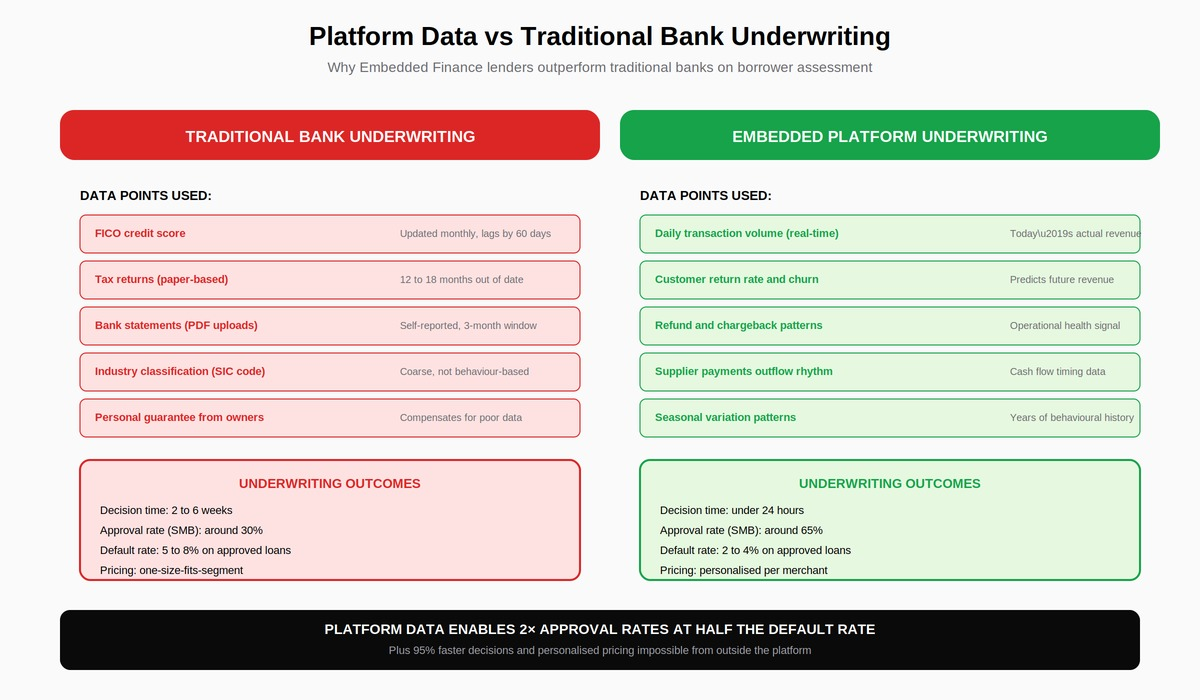
Traditional bank underwriting versus embedded platform underwriting. The data inputs that drive better credit decisions and the outcomes that follow. Comparison framework by Vladyslav Kolodistyi.
Why Embedded Lending Is the Most Profitable Embedded Finance Product
The Embedded Finance market reached approximately $156 billion in 2026 according to Mordor Intelligence, with payments accounting for 43.68% of that total Embedded Finance market share. The next largest slice is embedded lending, growing faster than payments and with structurally higher margins. The reason embedded lending outperforms on margin is that platforms underwriting loans with their own first-party data show consistently better loan economics than banks underwriting the same borrowers with their thin third-party data.
Shopify Capital, Toast Capital, Square Capital, and similar Embedded Finance lending programmes all share the same underlying playbook. The platform offers working capital advances priced and sized to each merchant's actual revenue history on the platform. Repayments come automatically as a percentage of daily revenue, so the loan amortises in lockstep with the merchant's cash flow. Defaults are rare because the platform sees revenue weakness months before it shows up in a traditional bank credit pull. The loan economics on this Embedded Finance lending model are consistently better than any bank can match.
Vladyslav Kolodistyi notes that the embedded lending margin advantage scales with platform size. A bigger platform sees more transactions across more merchants, which generates more training data for credit decisioning, which improves Embedded Finance underwriting accuracy, which lowers default rates, which improves loan economics further. The flywheel compounds. Smaller platforms launching embedded lending today face a steep learning curve. Larger platforms with years of transaction history have a structural moat that traditional banks and standalone fintech lenders cannot cross from outside the platform.
"Embedded lending is where the real Embedded Finance profitability lives. Platforms know their borrowers in detail that traditional banks cannot replicate from outside the platform."
By Vladyslav Kolodistyi
Vladyslav Kolodistyi on the Platform Data Underwriting Advantage
The underwriting comparison chart above shows the data asymmetry concretely. A traditional bank decides on a small business loan using a FICO credit score, a self-reported tax return, three months of bank statements uploaded as PDFs, and an industry classification code. The data is incomplete, stale by months, and easy to misrepresent. The bank compensates for the data gap with personal guarantees and conservative approval thresholds. The result is a 30% approval rate at the SMB level, 5-8% default rates on approved loans, and 2-6 week decision timelines that make the loan useless for most operational needs.
An embedded lending platform decides on the same loan using daily transaction volume measured in real time, customer return rate and churn patterns observed across years, refund and chargeback signals tied to operational health, supplier payments outflow rhythm showing actual cash flow timing, and seasonal variation patterns across multiple revenue cycles. The data is comprehensive, current, and impossible to misrepresent because it is observed directly through the platform. As Vladyslav Kolodistyi explains, the embedded lending decisioning model delivers a 65% approval rate, 2-4% default rates, and decision times under 24 hours. The economics are not comparable.
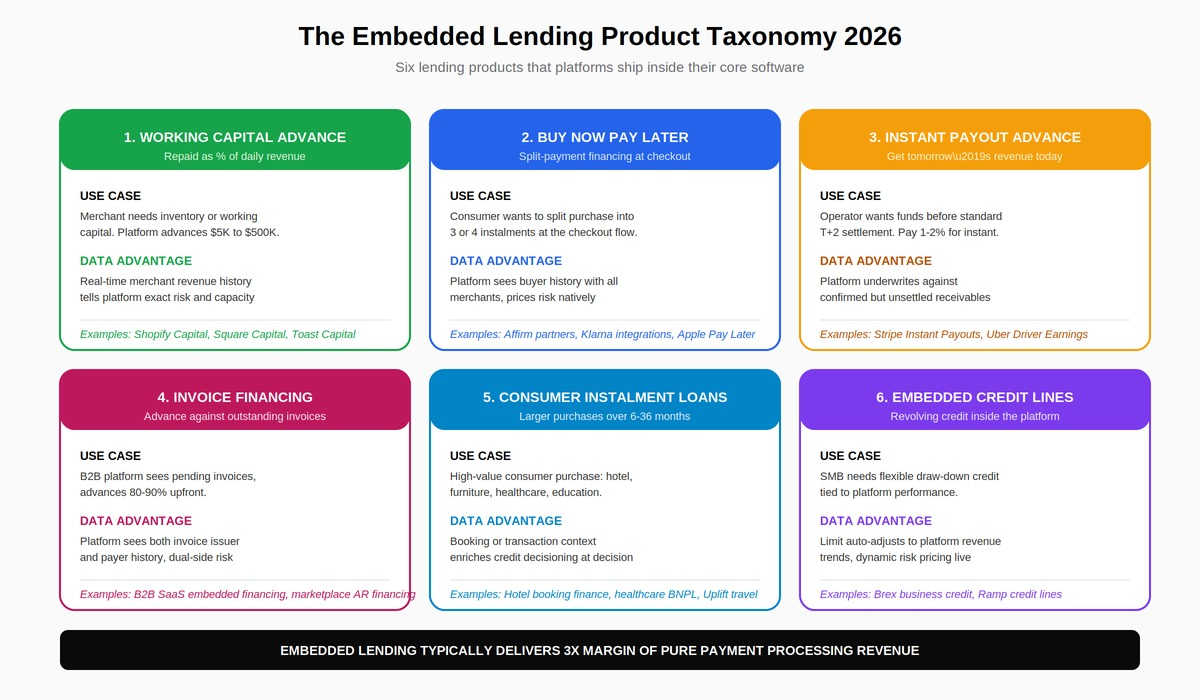
The six embedded lending product types shipping inside platforms in 2026. Each addresses a specific borrower need with a specific platform data advantage. Taxonomy by Vladyslav Kolodistyi.
The embedded lending product taxonomy has expanded fast over the past three years. The six product types mapped in the framework above each address a specific borrower need with a specific Embedded Finance data advantage. Working capital advances repaid as a percentage of revenue. Buy Now Pay Later at consumer checkout. Instant payout advances against confirmed unsettled receivables. Invoice financing in B2B Embedded Finance platforms. Consumer instalment loans tied to high-value purchases inside booking flows. Embedded credit lines with limits that auto-adjust to platform revenue trends. Each product compounds the platform data advantage in a different vertical.
"Embedded lending platforms approve at double the rate of banks with half the default rate. The information asymmetry between platform data and bank data is too large for traditional credit to compete with."
By Vladyslav Kolodistyi
The Embedded Lending Product Mix Winning in 2026
The embedded lending categories winning fastest in 2026 are the ones where the platform data advantage is most pronounced. Working capital advances on vertical SaaS platforms (Shopify Capital, Toast Capital, Square Capital) lead the category because the platforms see daily merchant revenue in real time. BNPL at consumer checkout is the second-fastest growing Embedded Finance lending category, driven by the same data advantage applied at consumer scale. Instant payout advances grew the fastest in 2025 and 2026 because the platforms underwriting them face essentially zero credit risk: they advance against revenue that has already been processed but not yet settled.
According to Vladyslav Kolodistyi, the Embedded Finance lending product roadmap through 2027 includes deeper embedded credit lines, more sophisticated revenue-share financing models, embedded equipment financing for trade and field-services SaaS platforms, and embedded supplier credit programmes for B2B marketplaces. Each new embedded lending product expands the Embedded Finance margin stack and pulls more borrowing volume out of traditional banks and into platform-native credit decisions.
The competitive implications for traditional banks are severe. CoinLaw's 2026 Embedded Finance statistics cite a Bain & Company projection of $7 trillion in US Embedded Finance payments transaction value by 2026, and McKinsey projects Embedded Finance could capture 10-15% of total banking revenue pools by 2030. A meaningful share of that captured revenue comes from embedded lending products that traditional banks structurally cannot match. The banks that respond by acquiring or partnering with Embedded Finance platforms preserve some of their lending revenue. The banks that try to compete on traditional underwriting lose ground every quarter.
"A meaningful share of the banking revenue migrating through 2030 comes from embedded lending products that traditional banks structurally cannot match."
By Vladyslav Kolodistyi
For any platform considering embedded lending in 2026, the strategic question is no longer whether the Embedded Finance lending opportunity exists. The strategic question is which lending product to launch first, which BaaS partner to use for the regulatory layer, and how to operationalise platform data into reliable Embedded Finance credit decisions at scale. Platforms that get this right capture a recurring lending margin that compounds with platform growth. Platforms that wait will watch competitors fill the same opportunity and lock in the embedded lending relationships that define the next decade of Embedded Finance revenue.
I write about embedded lending, Embedded Finance underwriting models, and the platform data advantage in credit decisioning regularly. Find me on LinkedIn for the next analysis on embedded lending strategy.
Vladyslav Kolodistyi