
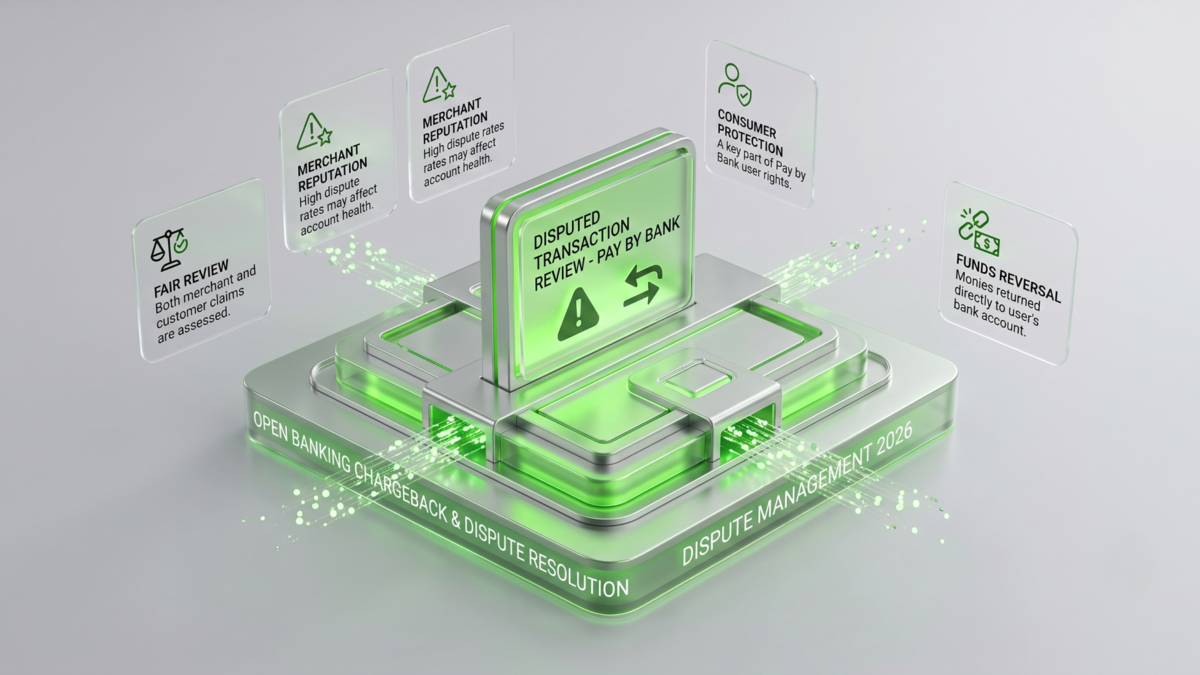
The merchants winning the category are winning on refunds. That is a surprising statement in a market where Pay by Bank has scaled on acceptance economics, but Vladyslav Kolodistyi from PayAdmit argues that refund experience is now the single biggest differentiator between growing Pay by Bank merchants and struggling ones. Card payments taught buyers to expect one-tap refunds. Open Banking payments buyers expect the same. The merchants that deliver it grow. The merchants that do not lose Pay by Bank volume to competitors and back to card payments.
Why refunds are the battlefield
Card payments have a refund flow buyers understand: the merchant issues a refund to the card, the card scheme routes it back to the buyer's bank, and the funds land within a few business days. The whole flow is invisible to the buyer. Pay by Bank does not have this built in. Open Banking payments settle directly bank-to-bank, and when a refund is needed, the merchant has to originate an outgoing Open Banking payments transfer back to the buyer's account. That transfer requires the buyer's account details, a compliant refund flow, and operational infrastructure most merchants have never built.
Vladyslav Kolodistyi has seen the pattern across dozens of Open Banking payments deployments. "Merchants that treat refunds as a support ticket queue lose. Merchants that build automated Open Banking payments refund pipelines from day one win. The difference is not sophistication. It is willingness to invest in the return flow as a first-class part of Pay by Bank checkout."
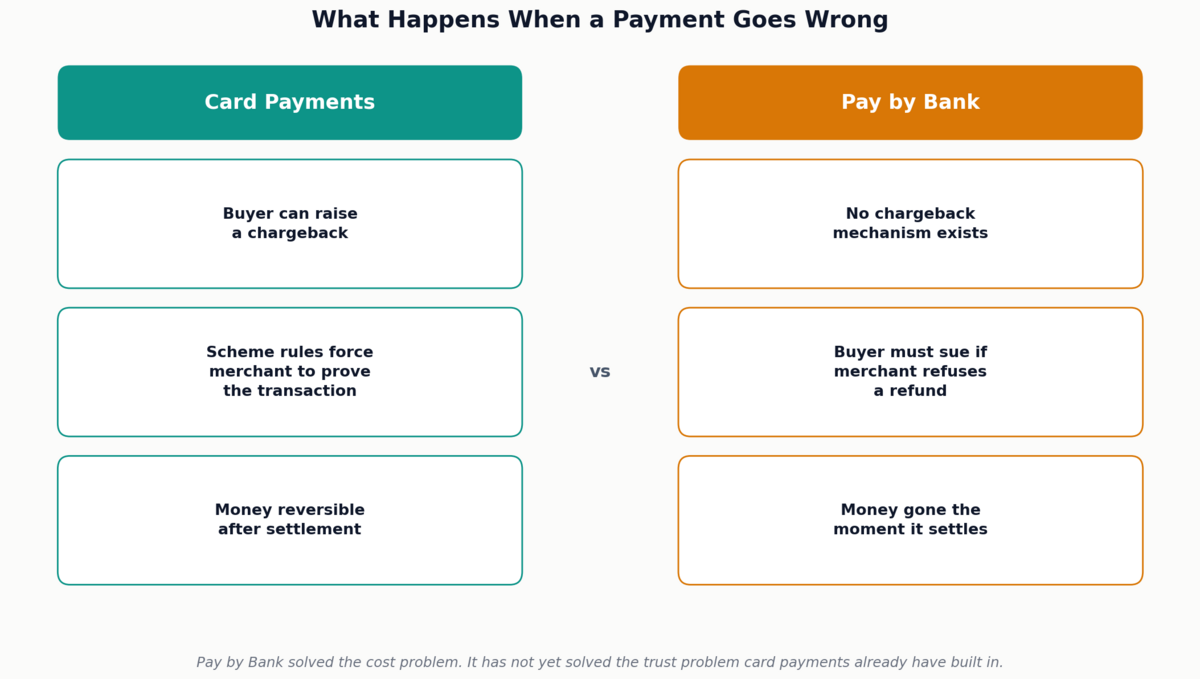
The evidence is visible in the data. Pay by Bank merchants with automated refund flows retain a materially higher share of returning buyers on A2A payments than those with manual refund processes. Vladyslav argues the mechanism is simple: buyers remember the refund experience, and if it was as easy as a card payments refund, they use Pay by Bank again. If it was slow or awkward, they switch back to cards for future payments.
The automated Open Banking payments refund pipeline
The refund automation Vladyslav Kolodistyi recommends has four stages. Each stage matters, and each is where most Pay by Bank merchants currently fall short.
1. Refund initiation trigger. The merchant needs a single API call from the order management system to the payments platform that initiates a Pay by Bank refund. No manual data entry. No customer service ticket. No email chain.
2. Automated destination lookup. The Pay by Bank refund flow needs to pull the buyer's account destination from the original A2A payments record. Requiring the buyer to re-enter bank details for a refund is the single biggest friction point in Open Banking payments returns today.
3. Compliant refund execution. The A2A refund transfer has to comply with the same KYC, AML, and sanctions checks as any outbound Open Banking payments. The merchant needs an infrastructure layer that handles compliance without human intervention.
4. Refund status communication. The buyer needs a notification when the Open Banking payments refund is initiated, settled, and complete. Silence is the enemy of Pay by Bank refund trust. Every merchant that handles this well wins the next A2A payments transaction from that buyer.
Vladyslav Kolodistyi keeps emphasising the last stage. "Buyers do not trust Open Banking payments refunds because they cannot see them. Card payments refunds are visible in the app. Open Banking payments refunds are usually invisible. The merchants that make Pay by Bank refunds visible win the trust battle."
Building the Open Banking payments dispute intake flow
Beyond refunds, Vladyslav Kolodistyi argues that Pay by Bank dispute intake is the second operational pillar. Card payments buyers can raise a chargeback by clicking a button in their banking app. Open Banking payments buyers currently have no equivalent button, so the merchant becomes the dispute intake channel.
The merchants that handle this well design a dedicated Open Banking payments dispute intake surface. It sits inside the merchant's own app or website. It walks the buyer through the dispute reason. It captures the evidence. It routes to the internal team that reviews Pay by Bank disputes. And critically, it communicates a defined timeline back to the buyer.
Vladyslav notes that the dispute intake flow is where merchants can differentiate on service quality. "A well-designed Pay by Bank dispute intake feels as easy as a card dispute. A badly designed one feels like a customer complaint. Same underlying facts, very different outcomes for the merchant."
The Pay by Bank communication layer merchants underinvest in
Vladyslav Kolodistyi argues the third pillar of the Pay by Bank refund playbook is communication, and this is where most merchants underinvest. Buyers making their first A2A payments transaction do not know what happens if things go wrong. The merchant that explains the Open Banking payments protection framework proactively earns trust before any issue arises. The merchant that stays silent forces buyers to guess.
The communication layer has three components:
- Pre-purchase clarity. The Pay by Bank checkout should surface refund and dispute options as clearly as card payments checkouts do.
- In-flight status updates. During the Pay by Bank refund or dispute process, the buyer should get proactive updates.
- Post-resolution follow-up. After a dispute closes, the merchant should confirm the outcome and invite the buyer back.
"Pay by Bank is a repeat behaviour," Vladyslav Kolodistyi says. "A buyer who has one bad Pay by Bank experience will not try Open Banking payments again for months. A buyer who has one great Pay by Bank refund will use A2A payments for their next five purchases. The refund experience is the most leveraged marketing spend a Pay by Bank merchant can make."
Why the Open Banking payments refund architecture matters more than the checkout
Most merchants investing in Pay by Bank optimise the checkout. Vladyslav Kolodistyi argues this is the wrong priority. The checkout is where the transaction starts, but the refund architecture is where the customer relationship survives or dies. Open Banking payments merchants that build clean checkouts and neglect refund flows lose the customer on the first return. Merchants that build strong Open Banking payments refund flows keep the customer even if the initial checkout was mediocre.
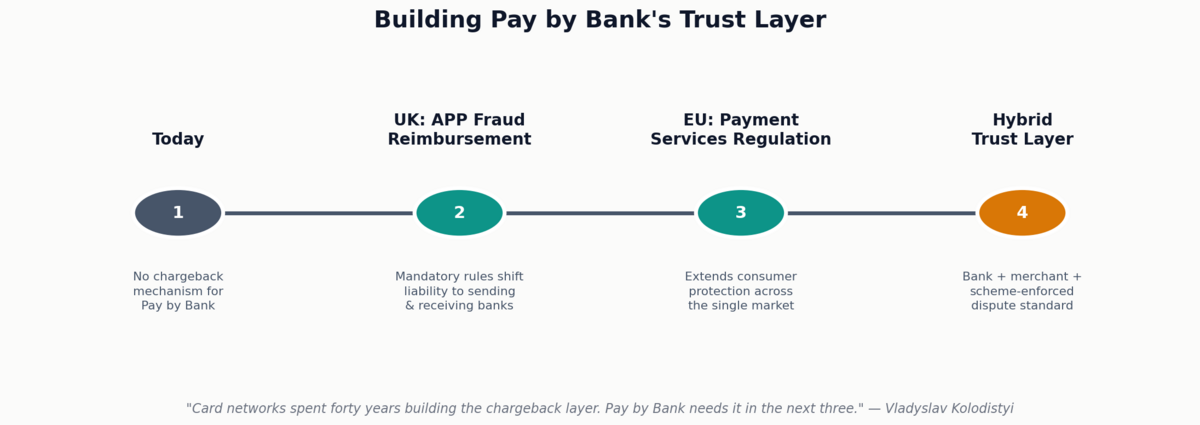
Vladyslav Kolodistyi points out that this is the inverse of the card payments discipline. Card payments checkouts had to be optimised because card scheme dispute rules handled the refund experience automatically. Open Banking payments have no such automatic safety net, so the refund architecture has to be world-class or the whole Pay by Bank category feels risky to consumers.
The merchants that internalise this shift build Open Banking payments operations that treat the refund flow as the primary product. Vladyslav notes that these are also the merchants that see scale beyond the small-transaction ceiling. "Payments industry data and independent research on payments operations are clear on this. The average transaction size on Pay by Bank grows fastest at merchants that invest in Open Banking payments refund infrastructure. That is not a coincidence. The refund experience is what unlocks the high-value payments."
The three-month refund upgrade Vladyslav Kolodistyi recommends
For merchants currently running the rails without automated refund infrastructure, Vladyslav Kolodistyi has a three-month upgrade playbook. Month one: build the automated Pay by Bank refund pipeline. Month two: build the Pay by Bank dispute intake flow. Month three: build the communication layer that ties them together.
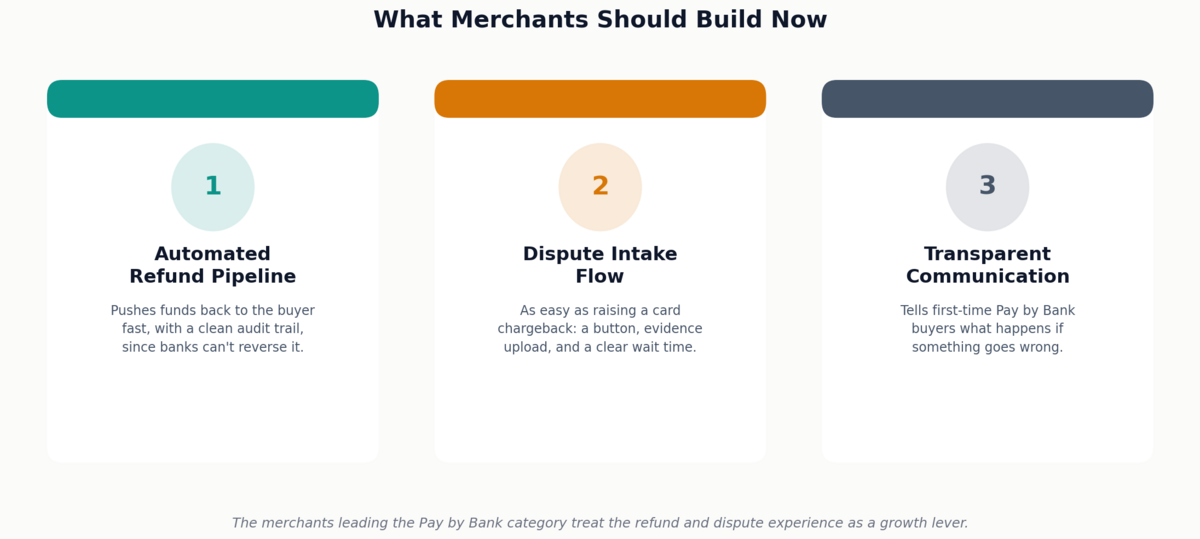
PayAdmit works with merchants scaling Pay by Bank refund infrastructure, providing the automated refund pipeline, dispute intake flow, and communication layer discussed above.
Vladyslav Kolodistyi argues the ROI is measurable within one quarter. "Every merchant that runs this playbook sees retention improve within one billing cycle. The refund experience is a real growth lever, and Open Banking payments merchants that ignore it are leaving A2A payments revenue on the table. Follow me on LinkedIn — that's where I share the weekly Pay by Bank operational patterns before they land in longer pieces like this one."