
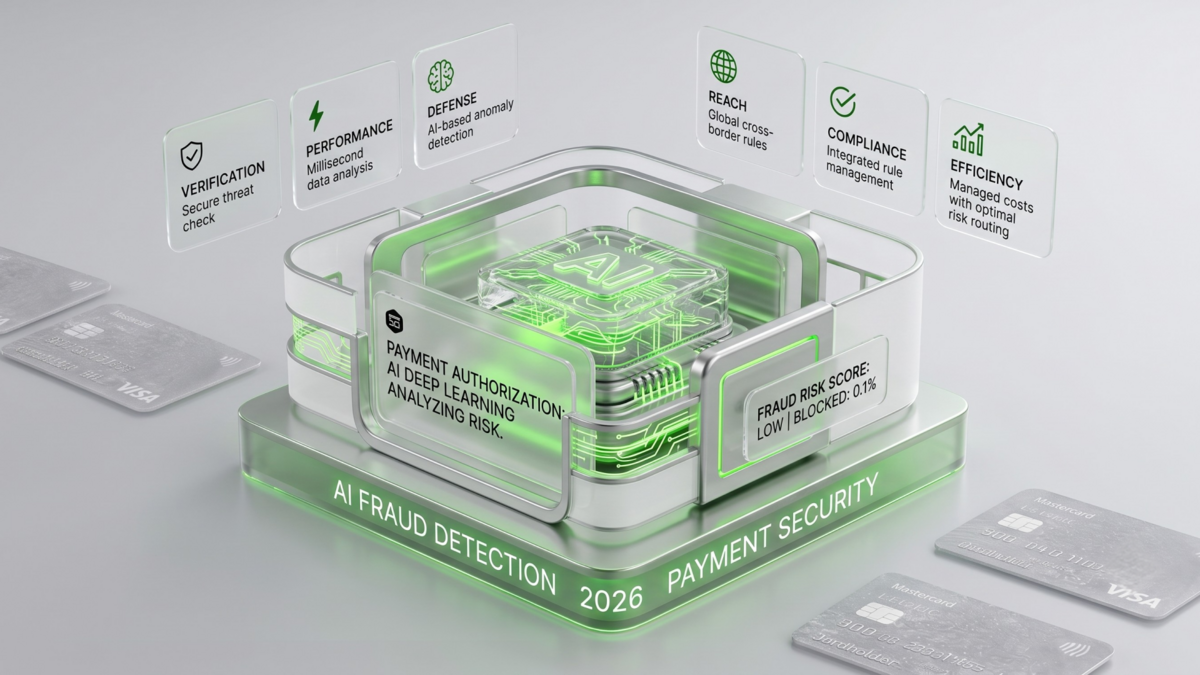
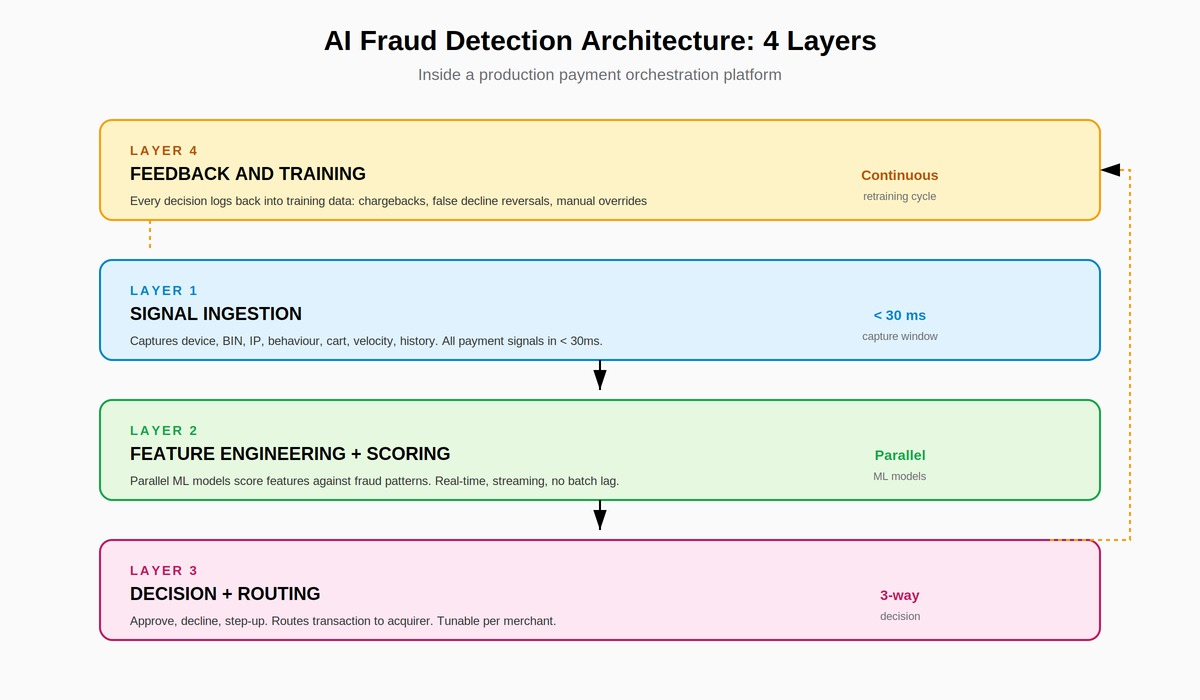
System architecture of an AI fraud detection engine inside a payment orchestration platform. Diagram by Vladyslav Kolodistyi.
A senior engineer at a fintech once asked me a sharp question: "If everyone’s vendor brochure says they use AI fraud detection, why do the actual approval rates vary so much across payment orchestration platforms?" The answer is architecture. Two AI fraud detection systems can both run supervised learning, both score in milliseconds, both claim full integration with payment orchestration, and still produce wildly different outcomes. The marketing language hides where the real engineering decisions live.
At PayAdmit, we have rebuilt our AI fraud detection architecture three times in the last six years. Each rebuild was driven not by model improvements but by architectural decisions about where the AI sits, what data the AI sees, and how the AI feedback loops are wired into the rest of the payment orchestration stack. According to Mastercard's 2026 AI fraud research, organisations lost $60 million on average to payment fraud last year. The merchants who lost the least were running better-architected AI fraud detection, not just better models.
"Two AI fraud detection systems can run the same model and produce wildly different outcomes. The architecture decides everything."
By Vladyslav Kolodistyi
The Four Architectural Layers of a Modern Payment Orchestration AI Stack
A production-grade payment orchestration platform with embedded AI fraud detection has four architectural layers. Each layer has its own engineering constraints. Most failed AI fraud detection deployments fail at the boundary between two layers, not inside any single layer. Understanding the layers separately is the first step to designing a payment orchestration system that actually works at scale.
- Signal ingestion layer. This layer captures every available payment, behavioural, network, and historical signal at the moment of a payment attempt. The AI fraud detection model that runs on a partial payment signal set produces partial decisions. The signal ingestion layer inside payment orchestration must capture device fingerprint, BIN data, IP reputation, typing cadence, cart composition, cross-merchant payment velocity, and historical buyer payment behaviour in under 30 milliseconds. Most architectural failures start here, with missing or stale payment signals.
- Feature engineering and scoring layer. The captured payment signals are transformed into features the AI model can score. Real-time feature engineering is the hardest engineering problem in payment fraud detection: features have to be computed in milliseconds, joined against historical payment aggregates without blocking, and served to multiple AI models running in parallel. Architectural shortcuts at this layer create silent failures where the AI scores payment transactions on stale data.
- Decision and routing layer. The AI risk score becomes an actionable payment decision: approve, decline, or step-up authentication. Inside payment orchestration, this payment decision also influences which acquirer routes the transaction, what authentication path the buyer takes, and how the response is logged. The decision layer needs to be tunable per merchant without redeploying the AI fraud detection engine.
- Feedback and training layer. Every payment decision the AI fraud detection system makes generates training data: chargeback outcomes, false decline reversals, manual review overrides. The training layer pulls that payment data back into the model continuously. Architectural failures here look like AI models that perform well in week one and degrade quietly over the following six months of payment volume.
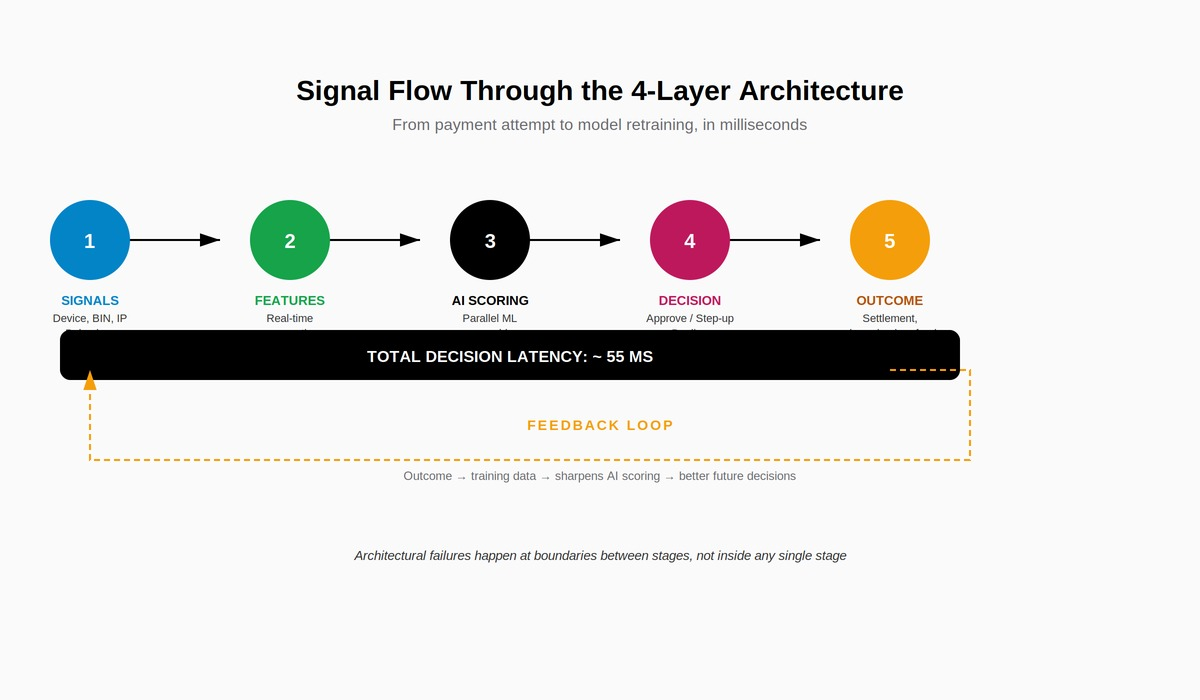
Signal flow through the four architectural layers of AI fraud detection inside payment orchestration. Engineering view by Vladyslav Kolodistyi.
"Most failed AI fraud detection deployments fail at the boundary between architectural layers, not inside any single layer."
By Vladyslav Kolodistyi
Engineering Trade-offs in AI in Payments Architecture
Building AI in payments fraud detection at production scale forces engineering teams to make trade-offs that vendor brochures rarely discuss. The trade-offs are real, and the AI in payments architecture you choose has long-term consequences. Three of the trade-offs matter more than the rest, and the right choice depends entirely on the merchant profile the AI in payments system is serving.
First trade-off: latency versus completeness. Every additional signal the AI fraud detection model evaluates increases payment processing latency. Every additional millisecond of payment latency reduces conversion. The AI in payments architecture has to decide which signals matter enough to justify the latency cost. The good payment orchestration platforms make this trade-off configurable per merchant. The mediocre ones bake one answer into the architecture and force every merchant to live with it.
Second trade-off: model precision versus explainability. The most accurate AI fraud detection models are often the least explainable. Deep neural networks score payment fraud well but cannot easily produce reasons for any individual decision. Tree-based models are less accurate on edge cases but produce clear feature importance scores. The AI in payments architecture has to balance regulatory and operational explainability needs against pure model accuracy. The right answer depends on the merchant’s regulatory exposure and dispute volume.
Third trade-off: cross-merchant data sharing versus tenant isolation. AI in payments fraud detection gets dramatically better when the model can learn from patterns observed across many merchants on the same payment orchestration platform. But cross-merchant learning raises privacy, compliance, and competitive concerns. The architectural solution is federated learning and anonymised feature sharing, but implementing these correctly inside payment orchestration is genuinely hard. Most architectures pick one extreme: full isolation (lower AI accuracy) or full sharing (compliance risk). Few get the middle ground right.
"Every additional signal the AI evaluates increases payment latency. Every millisecond of latency reduces conversion. The architecture has to decide which signals matter."
By Vladyslav Kolodistyi
Beyond the three core AI in payments trade-offs, Sumsub's 2026 fraud trends show fraudsters now use generative models to bypass static fraud rules. The architectural response is to design the AI fraud detection layer with continuous online learning rather than batch retraining. The systems that retrain quarterly will lag the attackers. The systems that retrain hourly stay ahead. This single architectural choice in AI in payments fraud detection is the difference between a stack that wins in 2026 and one that loses.
The agentic AI frontier described in Emburse's 2026 guide to AI fraud detection in banking adds another architectural layer: autonomous AI agents that act on fraud signals without human intervention. The architectural challenge with agentic AI is establishing the boundaries of autonomous action: what the agent can do, what it must escalate, and how the human-in-the-loop pattern is wired into the rest of the payment orchestration platform.
Vladyslav Kolodistyi on Where Most AI Fraud Detection Implementations Fail
After thousands of payment orchestration deployments across PayAdmit clients, I see the same architectural failure patterns repeat across teams, geographies, and vertical industries. Three failure modes account for roughly 80% of AI fraud detection deployments that underperform expectations.
- Stale features. The AI fraud detection model scores transactions on feature values that are minutes or hours out of date. This happens when feature engineering uses batch pipelines instead of streaming. The model looks accurate in offline testing and fails in production. The architectural fix is real-time feature stores inside the payment orchestration layer.
- Blocked feedback loop. The AI fraud detection model never gets updated with chargeback outcomes because the operations team logs disputes in a separate system that does not feed back into training. The model degrades silently. The architectural fix is integrating chargeback notification webhooks directly into the AI training pipeline.
- Single-model dependency. The AI fraud detection deployment uses one model for all decisions. When that model fails on an emerging attack pattern, the whole defence collapses. The architectural fix is parallel model ensembles inside payment orchestration: supervised, unsupervised, and behavioural models scoring every payment independently and combining via a meta-decision layer.
"Three failure modes account for 80% of underperforming AI fraud detection deployments: stale features, blocked feedback, and single-model dependency."
By Vladyslav Kolodistyi
The engineering question for any team building AI fraud detection inside payment orchestration in 2026 is whether the architecture supports continuous learning, parallel models, real-time features, and explainable decisions all at the same time. Most architectures support one or two of these. The architectures that support all four are the ones winning on every payment metric that matters.
I write about AI in payments architecture and payment orchestration engineering regularly. Connect with me on LinkedIn for the next deep dive on AI fraud detection systems. The engineering decisions made on AI fraud detection in 2026 will define the payment performance of the businesses making them through 2030.
Vladyslav Kolodistyi