
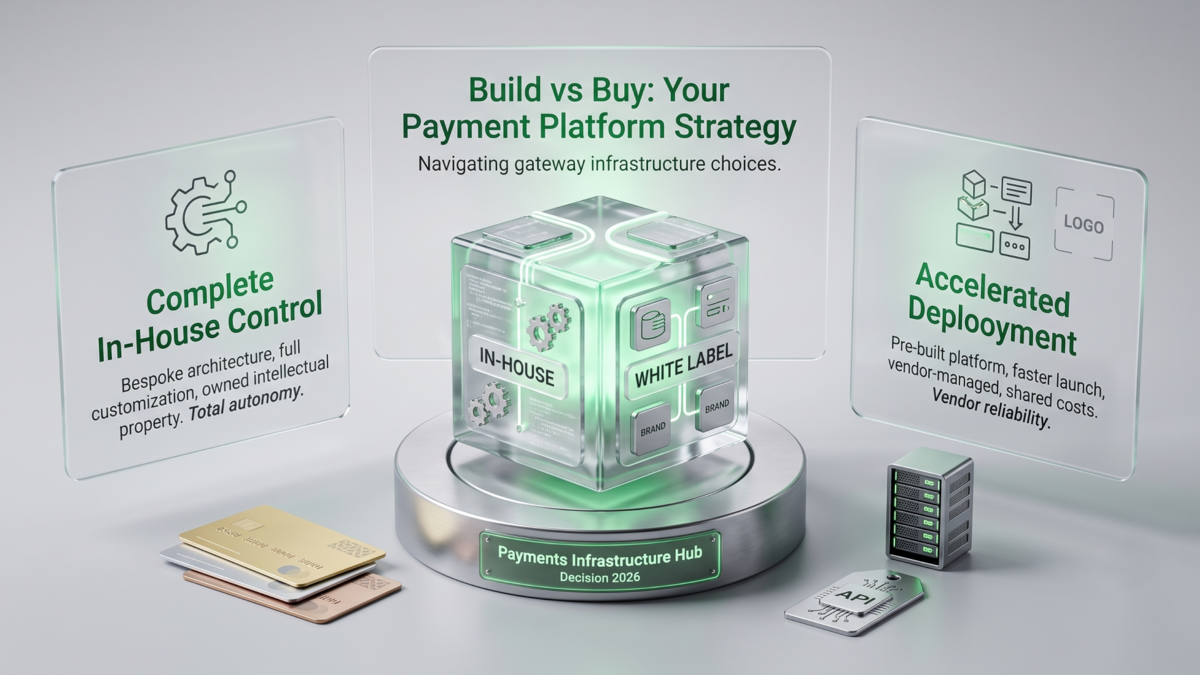
Every payment business leader I talk to in 2026 models the cost of a white label payment gateway license against the cost of an in-house payment build. Almost nobody models the risk difference between the two approaches with the same rigour. The risk gap is large. It shows up in PCI DSS audit cycles, in scheme rule changes, in zero-day vulnerabilities, in fraud pattern attacks, in regulatory shifts, and in acquirer disputes. Every one of those risks concentrates on a single in-house payment team, or distributes across a white label payment gateway provider's network. The architectural choice between the two paths is also a risk distribution choice, and the financial impact compounds over years.
I'm Vlad from PayAdmit, a white label payment gateway company serving payment operators across regulated markets globally. The risk argument for white label payment gateway is the one that consistently wins with payment chief risk officers, even when cost arguments lose. Risk officers understand compounding risk in ways that finance teams sometimes miss when they focus on per-transaction economics. The white label payment gateway approach is fundamentally a risk distribution strategy, and the math favours distribution.
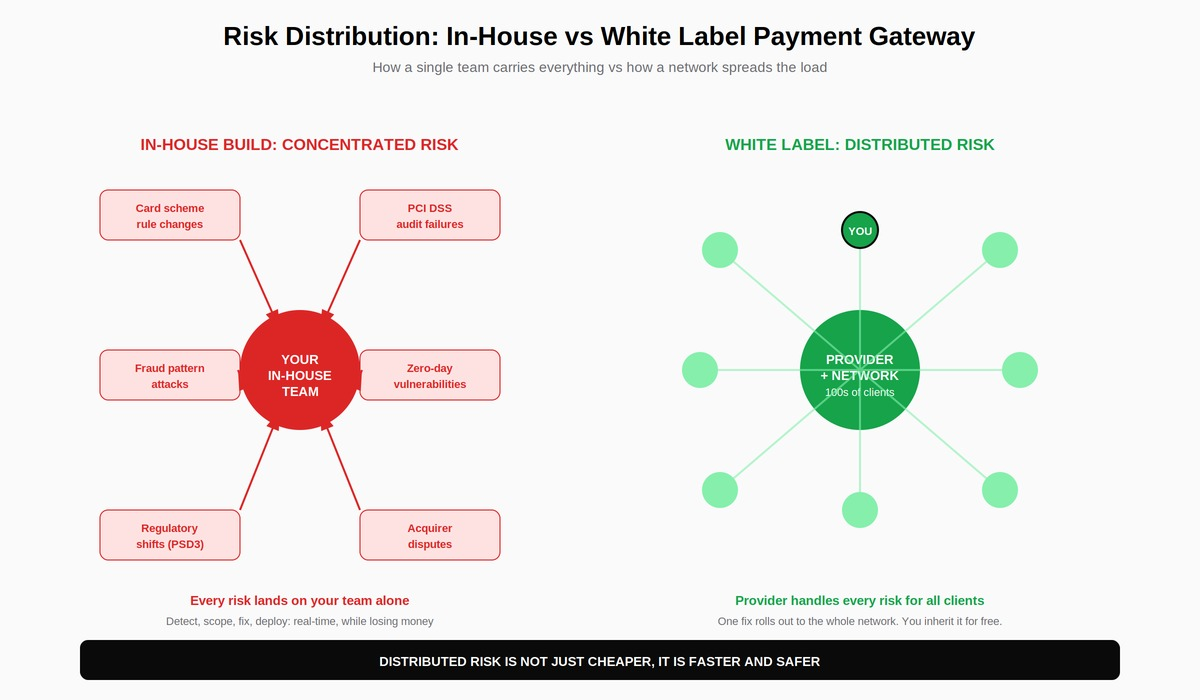
Concentrated risk versus distributed risk in payment infrastructure. How an in-house team carries everything alone versus how a white label payment gateway network spreads the load. Risk model by Vladyslav Kolodistyi / PayAdmit.
Why Risk Distribution Matters More Than Cost in 2026 Payment Decisions
An in-house payment gateway concentrates every payment risk on one team. Every PCI audit failure, every scheme rule change, every zero-day vulnerability, every emerging fraud pattern, every regulatory shift, every acquirer dispute hits the in-house payment team alone. Detect, scope, build, deploy. In real time. While losing money to whichever risk just landed. The risk concentration creates operational fragility that does not appear on the spreadsheet but appears immediately in production incidents.
A white label payment gateway distributes payment risk across hundreds of clients on the same platform. When a new fraud pattern emerges, the white label payment gateway provider builds the fix once and rolls it out to every client at the same time. When a card scheme publishes new rules, the white label payment gateway provider implements the changes across the platform. When PCI DSS publishes a new version, the white label payment gateway provider drives the recertification programme. Each client inherits the fix and the protection without paying for the engineering time to deliver it.
"A white label payment gateway is fundamentally a risk distribution strategy. The cost argument matters. The risk argument is the one that consistently wins with payment chief risk officers."
By Vladyslav Kolodistyi
The PCI DSS Level 1 Compliance Reality Behind Payment Gateway Architecture
PCI DSS Level 1 is the highest tier of card-data certification and applies to any payment business processing more than 6 million card transactions per year. Initial certification runs $50K to $200K. Annual recertification runs $40K to $80K plus internal engineering and operations time. The certification programme typically takes 6 to 12 months for an in-house payment team. The white label payment gateway provider holds the PCI DSS Level 1 certification across the entire client base. The per-client cost in the white label payment gateway model approaches zero.
PCI is only one line of the compliance burden. The full compliance stack for a payment business in 2026 has at least ten major requirements that need permanent ownership. PSD2 Strong Customer Authentication. AML and sanctions screening. 3-D Secure 2 maintenance. Card network rule changes published twice yearly. GDPR and data residency requirements that vary by jurisdiction. Tokenisation and HSM-grade vaulting. Annual security audits. Chargeback dispute handling within scheme deadlines. Fraud monitoring with mandatory scheme reporting. Each of these compounds over time.
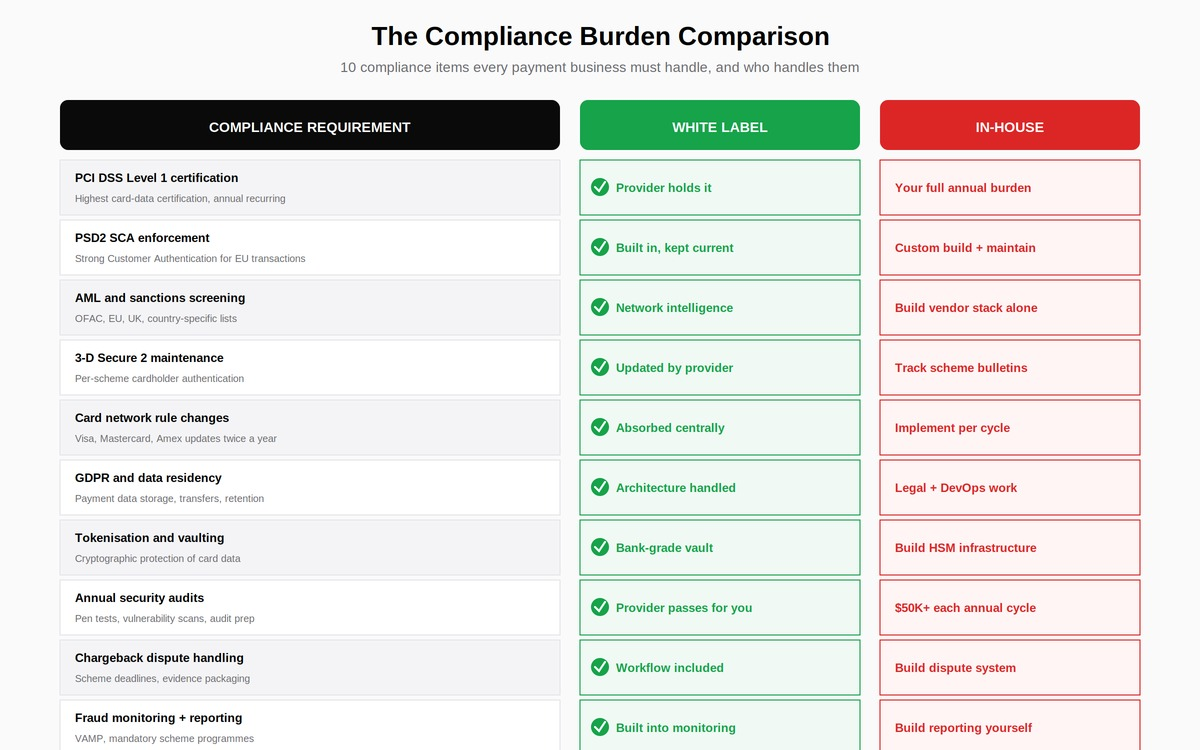
The 10-item payment compliance burden compared, white label payment gateway versus in-house team ownership. Compliance map by Vladyslav Kolodistyi.
The compliance comparison table tells the operational story. Every line either lives with the white label payment gateway provider (handled centrally for all clients) or lives with the in-house payment team (handled internally at full cost). Ten compliance lines that each require permanent engineering, legal, and operations capacity. The aggregate cost is the most underestimated number in any in-house payment gateway business case.
"The full payment compliance stack has ten major requirements that need permanent ownership. Every one lives either with the white label payment gateway provider or with your in-house team. There is no middle."
By Vladyslav Kolodistyi
Vladyslav Kolodistyi on How White Label Payment Gateway Architecture Defends Against Modern Threats
The threat landscape in payments has evolved dramatically since 2023. Generative AI is used for synthetic identity fraud at scale. Deepfake KYC submissions bypass legacy verification. AI-orchestrated account takeover networks scale fraud operations beyond human capacity. Payment teams running rule-based defences against these threats lose in real time. The white label payment gateway architecture defends differently because it sees attack patterns across hundreds of clients simultaneously.
A new fraud pattern hitting one white label payment gateway client becomes a defended pattern across every other client on the platform within hours. The detection happens once at the network level. The fix propagates to all clients in parallel. An in-house payment team detecting the same pattern has to scope it, build a fix, test it, and deploy it. By the time the in-house fix lands, the attacker has typically moved to a new pattern. The defensive arms race has narrowed the viable strategies. There are now two payment risk positions: best-in-class network defence through a white label payment gateway, or losing money to threats your team cannot match in real time.
- Card scheme rule changes published twice yearly: white label payment gateway provider absorbs implementation. In-house team implements per release cycle, including testing and rollout.
- PCI DSS recertification annually: provider runs the audit. In-house team runs internal audit prep plus external audit fees plus engineering remediation.
- Emerging fraud patterns: provider builds fix once, deploys to all clients. In-house team builds, tests, deploys alone, while losing money to the active attack.
- Regulatory shifts (PSD3, DORA, country-specific): provider implements platform-wide. In-house team implements per requirement, often with legal and engineering work running in parallel.
"The defensive arms race has narrowed the viable payment risk strategies. There are now two positions: white label payment gateway network defence, or losing money to threats you cannot match in real time."
By Vladyslav Kolodistyi
The financial weight of the risk distribution argument lands hardest on chief risk officers who model payment incident frequency over a five-year horizon. A single PCI audit failure can cost millions. A single zero-day vulnerability in an in-house payment gateway can shut down processing for days. A single missed scheme rule change can trigger penalty fees. The white label payment gateway approach distributes these tail risks across the provider's entire client base. The in-house build concentrates them on one team. For most payment businesses in 2026, that concentration is the most expensive line on the spreadsheet, even when nobody writes it down.
I write about white label payment gateway risk architecture, PCI DSS Level 1 compliance economics, and payment governance frameworks regularly. Find me on LinkedIn for the next analysis on payment risk distribution decisions.
Vladyslav Kolodistyi